

For decades, F5 has been a cornerstone of application delivery in banking environments. Its performance, reliability, and deep feature set have made it a trusted platform for some of the world’s largest financial institutions.
But as digital banking becomes truly always-on, regulatory expectations rise, and cyber threats grow more sophisticated, one reality is becoming clear:
No single load balancer—no matter how powerful—should be a single point of failure.
Today, forward-thinking banks are adopting a backup (secondary) load balancer strategy alongside F5, not to replace it, but to strengthen resilience, reduce vendor risk, and ensure uninterrupted digital banking services.
Why F5 Is Widely Used in Banking
F5’s presence in banking is well earned. Financial institutions rely on it for:
- High-performance Layer 4 and Layer 7 load balancing
- SSL/TLS offloading at scale
- Application traffic visibility
- Proven stability in mission-critical environments
For many banks, F5 forms the primary application delivery layer for core banking systems, customer portals, payment platforms, and APIs.
However, primary does not mean sufficient on its own.
The Risk of Relying on a Single Load Balancer Vendor
Banks are experts at managing financial risk—but vendor concentration risk in IT infrastructure is often underestimated.
Relying solely on one load balancing platform introduces several vulnerabilities:
1. Vendor Lock-In
A single-vendor strategy limits architectural flexibility and negotiating leverage, especially as licensing and capacity requirements grow.
2. Upgrade and Patching Risk
Even planned upgrades or security patches can introduce outages. Without a secondary platform, rollback options are limited.
3. Platform-Level Incidents
No vendor is immune to:
- Software bugs
- Misconfigurations
- Certificate or licensing failures
When these occur, a backup ADC can mean the difference between minutes of disruption and hours of downtime.
4. Capacity Exhaustion
Unexpected traffic surges—salary days, market volatility, or fraud events—can push a single platform to its limits.
5. Supply Chain and EOL/EOS Risk
Hardware refresh cycles, component shortages, or product lifecycle changes can impact availability planning.
In banking, availability risk is business risk.
Regulatory and Compliance Expectations Are Driving Change
Regulators increasingly expect banks to demonstrate operational resilience, not just theoretical redundancy.
Key expectations include:
- No single point of failure in critical systems
- Proven disaster recovery and failover testing
- Third-party and vendor risk management
- Rapid recovery from technology incidents
A multi-vendor or backup ADC strategy helps banks meet these expectations by showing architectural diversity and contingency planning.
What a Backup Load Balancer Strategy Looks Like
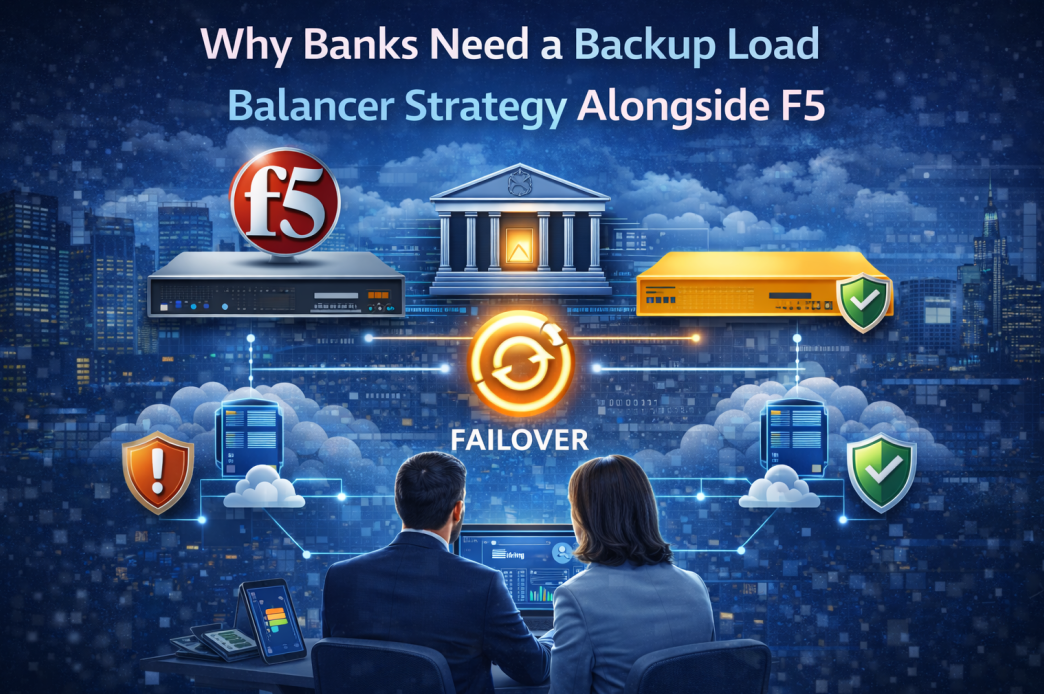
A backup load balancer strategy does not mean ripping out F5. Instead, it introduces a complementary ADC that can take over when needed.
Common models include:
Active-Passive Architecture
- F5 remains primary
- Backup ADC is on standby
- Traffic shifts during incidents, maintenance, or testing
Active-Active with GSLB
- Traffic is distributed across platforms or regions
- Faster recovery and load sharing
- Higher overall resilience
Disaster Recovery (DR) Focus
- Secondary ADC is activated during regional or data center failures
- Integrated with DNS or Global Server Load Balancing (GSLB)
The goal is simple: ensure applications remain reachable even when the primary platform is unavailable.
Benefits of a Secondary ADC Alongside F5
Implementing a backup load balancer strategy delivers tangible advantages:
Reduced Single-Vendor Risk
No single platform outage can take down critical banking services.
Improved Change Management Safety
Upgrades, configuration changes, and patches can be tested without customer impact.
Faster Recovery Times
Failover becomes automated and predictable, reducing Mean Time to Recovery (MTTR).
Cost and Capacity Flexibility
Secondary platforms can absorb overflow traffic or act as burst capacity.
Stronger Regulatory Posture
Demonstrates resilience, preparedness, and vendor risk mitigation.
In short, a backup ADC acts as insurance for digital banking availability.
Why Edgenexus Works as a Backup to F5
Edgenexus is increasingly adopted by banks as a secondary or backup ADC because it complements existing F5 environments rather than competing with them directly.
Key reasons include:
Interoperability with Existing Architectures
Edgenexus integrates cleanly into environments where F5 already operates, enabling cross-platform failover and traffic steering.
Global Server Load Balancing (GSLB)
Enables intelligent routing across regions and data centers, critical for DR and geographic resilience.
Integrated Security
Built-in Web Application Firewall (WAF) and SSL/TLS offloading protect banking applications during both normal operation and failover events.
Hybrid and Cloud Readiness
Edgenexus runs on-premises, in private cloud, or public cloud—ideal for modern banking architectures.
Operational Simplicity
Centralized management and automation reduce operational overhead compared to managing multiple heavy platforms.
Cost-Effective Resilience
Provides enterprise-grade capability without the high incremental cost of duplicating primary infrastructure.
Real-World Banking Scenarios Where Backup ADCs Matter
Consider common situations banks face:
- Planned F5 maintenance or upgrades
Backup ADC ensures uninterrupted service. - Licensing or capacity exhaustion
Traffic can be redirected instantly. - Regional data center outage
Secondary ADC handles failover via GSLB. - Security incident isolation
Traffic can be diverted while the investigation occurs.
In each case, a backup load balancer prevents customer-visible outages.
Conclusion
F5 remains a trusted and powerful platform in banking environments—but trust should not equal dependency.
As digital banking becomes more critical, banks must plan not just for performance, but for failure scenarios. A backup load balancer strategy alongside F5:
- Reduces operational and vendor risk
- Strengthens regulatory compliance
- Improves uptime and recovery
- Protects customer trust
Platforms like Edgenexus provide banks with a practical, cost-effective way to add resilience without disruption—ensuring digital banking services remain secure, available, and reliable at all times.
Next Steps
Learn how Edgenexus complements F5 in banking environments.
Explore a secondary ADC strategy designed for resilience, compliance, and always-on digital banking.