


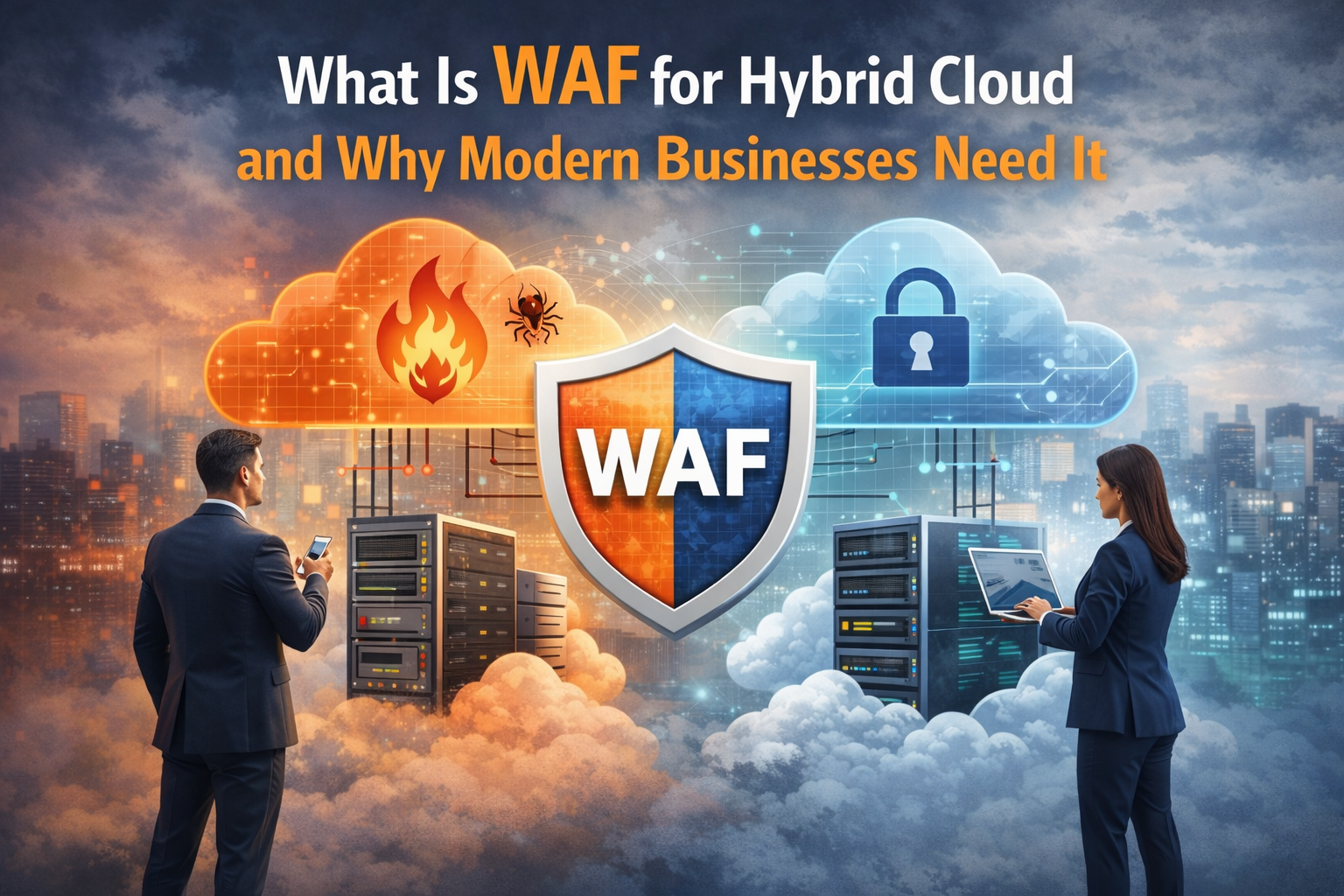
As businesses accelerate digital transformation, most organizations no longer operate in a single environment. Applications now run across on-premises data centers, private clouds, and public cloud platforms. This mixed setup, known as a hybrid cloud, offers flexibility and scalability, but it also introduces significant security challenges.
One of the most critical security controls in this environment is a Web Application Firewall (WAF).
Traditional network firewalls are no longer enough to protect modern, internet-facing applications. Today’s threats target the application layer (Layer 7), exploiting vulnerabilities in APIs, web apps, and microservices. This is where a WAF designed for hybrid cloud environments becomes essential.
1. What Is a Web Application Firewall (WAF)?
A Web Application Firewall (WAF) is a security solution that monitors, filters, and blocks malicious HTTP/HTTPS traffic before it reaches your applications.
Unlike traditional firewalls that focus on IP addresses and ports, a WAF operates at Layer 7, understanding application behavior and user requests.
A WAF protects against threats such as:
- SQL Injection
- Cross-Site Scripting (XSS)
- Cross-Site Request Forgery (CSRF)
- Remote File Inclusion (RFI)
- Bot attacks and scraping
- API abuse
- Zero-day exploits
2. What Does “WAF for Hybrid Cloud” Mean?
A Hybrid Cloud WAF is a Web Application Firewall that protects applications consistently across:
- On-premises infrastructure
- Private cloud environments
- Public clouds (AWS, Azure, GCP)
- Containerized and microservices-based deployments
Instead of deploying separate WAFs in each environment, a hybrid cloud WAF provides centralized visibility, policy enforcement, and security controls across the entire application landscape.
3. Why Traditional WAFs Fail in Hybrid Cloud Environments
Legacy WAF solutions were built for static, on-premises environments. In hybrid cloud architectures, they struggle due to:
- Fragmented security policies across environments
- Poor integration with cloud-native services
- Manual configuration and rule management
- Limited scalability during traffic spikes
- Lack of API and microservices awareness
- High operational complexity
As applications become distributed, security must become adaptive, automated, and environment-agnostic.
4. How a Hybrid Cloud WAF Works
A modern hybrid cloud WAF is typically deployed:
- As part of an Application Delivery Controller (ADC)
- As a virtual appliance
- At the edge, close to users
- Integrated with load balancing and traffic management
Traffic Flow
- User sends a request to the application
- WAF inspects the request at Layer 7
- Malicious traffic is blocked or challenged
- Clean traffic is forwarded to the backend
- Responses are also inspected before returning
This ensures end-to-end protection across all environments.
5. Key Benefits of WAF for Hybrid Cloud
5.1 Consistent Security Across All Environments
A hybrid cloud WAF applies the same security policies whether your application runs on-prem, in the cloud, or both.
✔ No security gaps
✔ Centralized policy control
✔ Uniform compliance enforcement
5.2 Advanced Protection Against Modern Threats
Hybrid cloud WAFs protect against:
- OWASP Top 10 vulnerabilities
- API-level attacks
- Automated bot traffic
- Credential stuffing
- Application-layer DDoS
This is critical as attackers increasingly target APIs and business logic.
5.3 Scalability Without Performance Loss
Modern WAFs scale dynamically with traffic. During peak usage:
- Additional capacity is added automatically
- Performance remains consistent
- No need for hardware upgrades
This makes hybrid cloud WAFs ideal for seasonal traffic spikes and global applications.
5.4 Better Visibility & Observability
Hybrid cloud WAFs provide:
- Real-time traffic analytics
- Attack insights
- Threat dashboards
- Detailed logs for auditing
This visibility helps security teams detect, respond, and improve defenses faster.
5.5 Simplified Compliance & Governance
For regulated industries, hybrid cloud WAFs help enforce:
- PCI DSS
- HIPAA
- GDPR
- SOC 2
By controlling access, masking sensitive data, and logging activity consistently across environments.
6. Why Modern Businesses Need a Hybrid Cloud WAF
Modern businesses face a perfect storm:
- More applications
- More APIs
- More users
- More cloud platforms
- More sophisticated attacks
Without a hybrid cloud WAF, organizations risk:
- Data breaches
- Downtime
- Compliance violations
- Revenue loss
- Brand damage
A hybrid cloud WAF ensures applications remain secure, available, and performant, regardless of where they are hosted.
7. Hybrid Cloud WAF vs Traditional Security Controls
| Capability | Traditional Firewall | Hybrid Cloud WAF |
| Layer 7 Protection | No | Yes |
| API Security | No | Yes |
| Cloud Support | Limited | Full |
| Centralized Policies | No | Yes |
| Auto-Scaling | No | Yes |
| Bot Protection | No | Yes |
| DevOps Integration | No | Yes |
8. How Edgenexus Delivers WAF for Hybrid Cloud
Edgenexus provides a built-in WAF as part of its modern ADC platform, designed specifically for hybrid and multi-cloud environments.
Key capabilities include:
- Layer 7 traffic inspection
- OWASP Top 10 protection
- Bot and scraper mitigation
- SSL/TLS offloading
- Integration with load balancing & GSLB
- FlightPath rule-based traffic control
- Centralized management across environments
- Virtual, cloud, and on-prem deployment
This allows businesses to secure applications at the edge, without sacrificing performance or flexibility.
Conclusion
Hybrid cloud environments are now the norm, but they also expand the attack surface dramatically. A traditional firewall alone cannot protect modern applications and APIs.
A Web Application Firewall for hybrid cloud is essential for defending against application-layer threats, ensuring compliance, and maintaining performance across distributed environments.
By combining WAF, intelligent traffic management, and cloud-native scalability, platforms like Edgenexus provide the security foundation modern businesses need to operate confidently in today’s digital landscape.
Frequently Asked Questions (FAQs)
1. What is a hybrid cloud WAF?
A hybrid cloud WAF protects applications across on-premises and cloud environments using unified security policies.
2. How is a WAF different from a firewall?
A firewall filters traffic based on IPs and ports, while a WAF inspects application-layer requests.
3. Why do hybrid cloud apps need a WAF?
Distributed applications are exposed to more attack vectors, especially at the application and API layer.
4. Can a hybrid cloud WAF protect APIs?
Yes. Modern WAFs include API security, rate limiting, and request validation.
5. Does a hybrid cloud WAF impact performance?
No. Modern WAFs are optimized to inspect traffic without adding latency.
6. Can WAF policies be centralized across environments?
Yes. Hybrid cloud WAFs provide centralized management and consistent policy enforcement.
7. Is WAF required for PCI DSS or GDPR compliance?
While not always mandatory, WAFs are strongly recommended and often expected in compliance audits.
8. Can a hybrid cloud WAF scale automatically?
Yes. It scales dynamically to handle traffic spikes and attack surges.
9. How does a WAF handle encrypted traffic?
It performs SSL/TLS termination, inspects traffic, and re-encrypts it securely.
10. How does Edgenexus support WAF in hybrid cloud?
Edgenexus delivers an integrated WAF with load balancing, GSLB, automation, and cloud-native deployment support.