
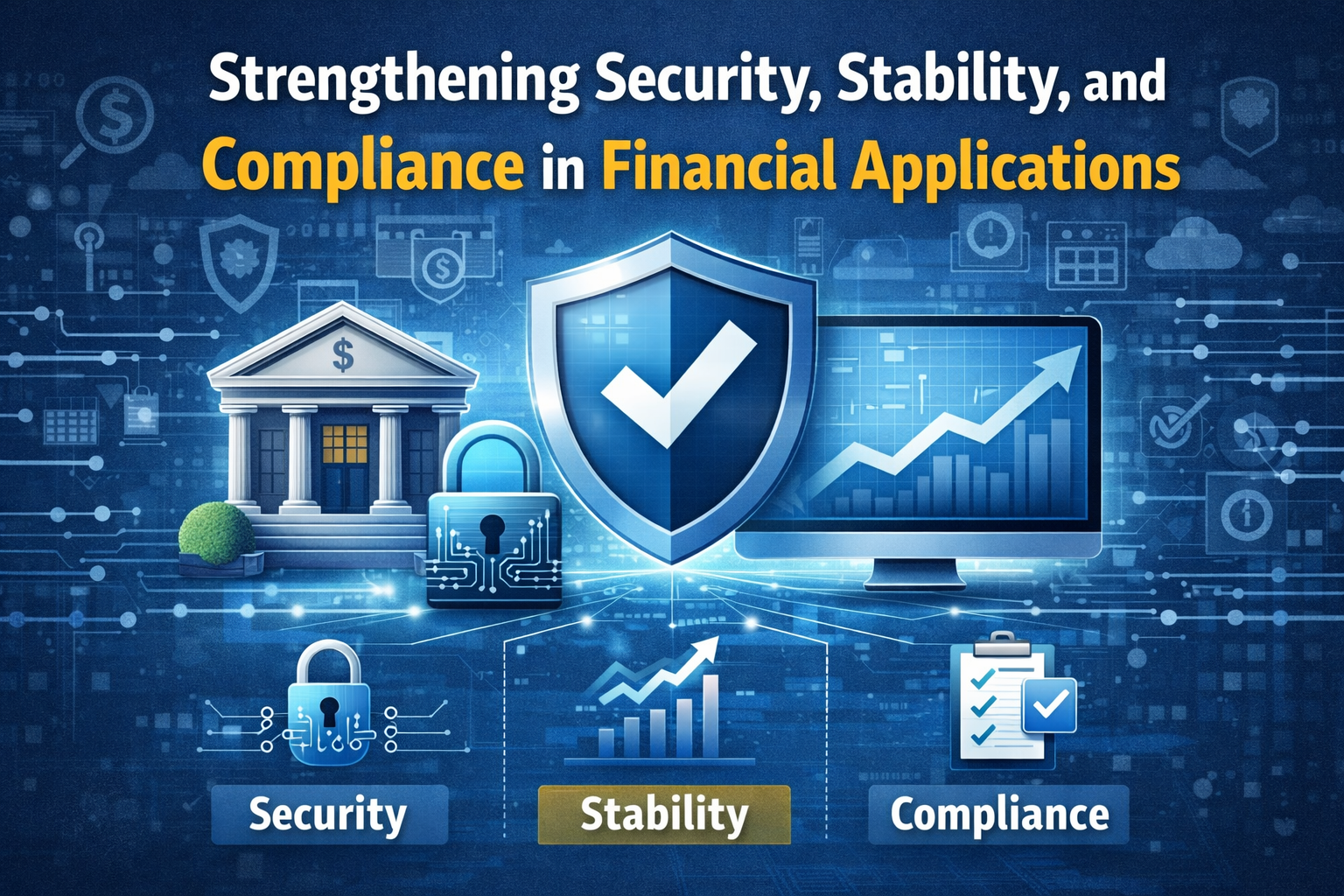
Financial applications sit at the core of modern banking, fintech, and financial services. From digital banking portals and payment systems to trading platforms and open banking APIs, these applications handle high-value transactions, sensitive data, and real-time operations.
As financial institutions continue their digital transformation, they face three inseparable priorities:
- Security – protecting applications and data from evolving threats
- Stability – ensuring continuous availability and performance
- Compliance – meeting strict regulatory and audit requirements
Strengthening all three simultaneously is no longer optional. It is essential for customer trust, regulatory approval, and business continuity.
Why Financial Applications Face Unique Risk
Financial applications are among the most targeted digital assets globally because they offer:
- Direct access to money
- Sensitive personal and financial data
- High transaction volumes
- Systemic impact when disrupted
Unlike other industries, even short outages or minor security incidents can trigger regulatory scrutiny, financial penalties, and reputational damage.
At the same time, modern financial applications are:
- Distributed across hybrid and multi-cloud environments
- API-driven and interconnected with partners
- Accessed 24/7 by global users
This complexity increases both the attack surface and operational risk.
The Security Challenge: Protecting the Application Layer
Traditional network security controls are no longer sufficient. Most modern attacks target the application layer (Layer 7), not the network perimeter.
Key security threats facing financial applications include:
- OWASP Top 10 vulnerabilities
- API abuse and manipulation
- Credential stuffing and bot attacks
- Application-layer DDoS
- Injection and logic-based attacks
To strengthen security, financial institutions must deploy application-aware protection, including:
- Web Application Firewalls (WAF)
- API security and rate limiting
- Encrypted traffic inspection
- Bot and fraud traffic mitigation
Security must be embedded into application delivery, not added as an afterthought.
Stability: Ensuring Always-On Financial Services
In financial services, availability equals trust.
Stability means ensuring:
- Zero or near-zero downtime
- Predictable performance during traffic spikes
- Fast recovery from failures
Common causes of instability include:
- Single points of failure
- Legacy infrastructure
- Manual failover processes
- Capacity exhaustion during peak demand
- Unplanned changes or upgrades
To strengthen stability, financial institutions must adopt:
- Active-active architectures
- Intelligent load balancing (L4/L7)
- Continuous health monitoring
- Automated failover and disaster recovery
- Global traffic management
Modern application delivery platforms play a critical role in maintaining stability across distributed environments.
Compliance: Meeting Regulatory Expectations by Design
Financial institutions operate under some of the world’s strictest regulatory frameworks, including:
- PCI DSS
- GDPR
- SOC 2
- Regional banking and operational resilience regulations
Regulators increasingly expect institutions to demonstrate:
- No single point of failure
- Strong vendor risk management
- Continuous monitoring and logging
- Proven disaster recovery and resilience testing
Compliance today is not just about documentation; it is about architectural evidence. Systems must be designed to:
- Enforce consistent security policies
- Log and audit application activity
- Maintain availability during incidents
- Protect customer data at all times
Why Security, Stability, and Compliance Must Work Together
Security, stability, and compliance are deeply interconnected:
- A security incident can cause downtime
- Downtime can lead to regulatory breaches
- Compliance gaps often expose security weaknesses
Treating these priorities in isolation creates risk. Financial institutions need unified platforms that deliver all three together.
Role of Modern Application Delivery Platforms
Modern Application Delivery Controllers (ADCs) provide a foundation for strengthening financial applications by combining:
- Load balancing and traffic optimization
- High availability and resilience
- Application-layer security
- SSL/TLS offloading
- Global Server Load Balancing (GSLB)
- Centralized visibility and automation
By operating at the application edge, ADCs ensure that every request is secure, monitored, and optimally routed.
How Edgenexus Supports Financial Application Resilience
Edgenexus provides a modern application delivery platform designed to meet the demanding requirements of financial services.
Key capabilities include:
- Integrated Web Application Firewall (WAF) for Layer 7 protection
- High-availability load balancing with active-active support
- Global Server Load Balancing for geographic resilience
- Intelligent traffic control using FlightPath rules
- SSL/TLS offloading for secure, high-performance transactions
- Hybrid and multi-cloud deployment support
- Centralized visibility and simplified operations
By unifying security, stability, and compliance controls, Edgenexus helps financial institutions reduce complexity while improving resilience.
Best Practices for Strengthening Financial Applications
Financial institutions should focus on:
- Eliminating single points of failure
- Embedding security at the application layer
- Automating failover and recovery
- Maintaining continuous monitoring and logging
- Designing architectures that satisfy regulatory expectations
- Regularly testing resilience and incident response
Strong financial application architecture is planned, tested, and continuously improved.
Conclusion
As financial services become increasingly digital, the stakes for application security, stability, and compliance continue to rise.
Strengthening financial applications requires:
- Application-aware security
- Always-on availability
- Compliance is built into infrastructure design
Modern application delivery platforms make it possible to achieve all three without sacrificing performance or agility.
By adopting unified, resilient architectures—and platforms like Edgenexus—financial institutions can protect customer trust, meet regulatory demands, and confidently deliver secure, stable, and compliant digital services.
Next Steps
Explore how Edgenexus helps financial institutions strengthen security, stability, and compliance across critical applications.
Learn how modern application delivery enables resilient, regulation-ready financial services.
Frequently Asked Questions (FAQs)
1. Why are security, stability, and compliance important for financial applications?
Financial applications process sensitive customer information and high-value transactions. Strong security, reliable performance, and regulatory compliance help prevent data exposure, service disruptions, and loss of customer confidence.
2. What security risks do financial applications commonly face today?
Financial applications often face risks, including insecure APIs, automated traffic abuse, unauthorized access attempts, and application-level performance disruptions that can affect availability and data protection.
3. Why is application-level security critical for modern banking platforms?
Modern banking systems rely heavily on applications and APIs. Protecting these layers ensures that business logic, user interactions, and backend services remain secure beyond traditional network-level controls.
4. How can service downtime affect compliance in financial services?
Unplanned downtime can interrupt regulated services, affect operational continuity, and raise compliance concerns related to availability, resilience, and customer access requirements.
5. What factors contribute to instability in financial applications?
Instability may result from outdated infrastructure, limited redundancy, manual recovery processes, unexpected traffic surges, or insufficient testing of backup and recovery mechanisms.
6. How do modern ADC platforms help improve application stability?
Modern ADC platforms support application stability through intelligent traffic distribution, automatic failover, real-time health checks, and optimized routing, ensuring continuous service availability.
7. Can compliance be integrated into financial application architecture?
Yes. Compliance can be built into application design through secure traffic handling, encrypted communications, detailed activity logging, controlled access, and resilient infrastructure planning.
8. Why is automation essential for financial application resilience?
Automation helps maintain consistent configurations, reduces manual intervention, accelerates recovery processes, and ensures applications can adapt quickly to changing traffic or system conditions.
9. How does a unified platform support security, stability, and compliance?
A unified platform simplifies management by combining protection, availability, and monitoring features into a single system, ensuring consistent enforcement and reduced operational complexity.
10. How does Edgenexus support secure and compliant financial applications?
Edgenexus provides application-level protection, high availability, intelligent traffic management, encrypted communication handling, and hybrid-cloud support to help financial organizations maintain secure, stable, and compliant services.