

Organizations across industries especially FinTech, e-commerce, and SaaS face increasing challenges: ensuring application security, achieving resilience, and managing microservices efficiently across hybrid and multi-cloud environments. Traditional load balancers no longer meet these needs; they must evolve into intelligent Application Delivery Controllers (ADCs) capable of securing, orchestrating, and scaling complex application infrastructures.
This is where Edgenexus redefines the game. Its combination of the FlightPath rule engine and the App Store within its modern load balancer ecosystem provides a holistic framework for application security, resilience, and microservices orchestration. Let’s take a deep dive into how these technologies work together to protect and optimize enterprise applications.
1. The Foundation: Modern Load Balancing with Edgenexus ADC
At its core, the Edgenexus ADC functions as a next-generation load balancer, but far beyond simple traffic distribution. It ensures that all incoming application traffic is managed intelligently for performance, security, and uptime.
Key Functions of the Load Balancer
- Layer 4 and Layer 7 Traffic Management: Enables content-based routing, session persistence, and granular traffic distribution based on application logic.
- SSL/TLS Offloading: Offloads encryption processes from backend servers, ensuring faster transactions and easier certificate management.
- High Availability & Failover: Supports active-passive and active-active clustering for maximum uptime.
- Health Monitoring: Continuously checks backend server status, removing unhealthy nodes automatically.
- Global Server Load Balancing (GSLB): Distributes traffic geographically for disaster recovery and global performance optimization.
This foundation sets the stage for what Edgenexus builds on top, FlightPath and the App Store, to transform a basic load balancer into a dynamic application delivery and security powerhouse.
2. FlightPath: Intelligent Traffic Control and Microservices Orchestration
FlightPath is Edgenexus’ built-in traffic management and rule engine that allows administrators to inspect, modify, and route HTTP/HTTPS traffic in real time. It provides precise control over how requests and responses are handled across your infrastructure, making it vital for security, compliance, and microservice management.
2.1. How FlightPath Works
Each rule within FlightPath is composed of:
- Condition: The criteria to identify specific traffic (headers, URL paths, GEO location, IP, etc.).
- Evaluation: Logic that defines how the traffic is interpreted or validated.
- Action: The operation to be performed, such as redirecting, rewriting, blocking, or modifying traffic.
2.2. Security and Control Advantages
- Threat Mitigation: Detect and block malicious requests, suspicious patterns, or unauthorized IPs before they reach backend systems.
- Data Compliance: Mask or remove sensitive data such as credit card numbers or personal information in transit.
- Dynamic Routing: Automatically reroute traffic based on server health, region, or policy ensuring resilience during downtime.
- Microservice Control: Easily direct traffic between versions of services for A/B testing, blue-green deployments, or canary rollouts.
- Protocol Enforcement: Force HTTPS or rewrite insecure URLs, ensuring consistent encryption practices.
2.3. Real-World Examples
- Block admin access from unapproved networks.
- Send the latest API version to a new service cluster and keep older versions active.
- Implement canary deployment where 5% of users experience a new microservice version.
- Send users to the right page depending on their region or language.
Send the latest API version to a new service cluster and keep older versions active.
FlightPath’s rule-based flexibility makes it an ideal tool for organizations seeking precision control without complex coding or redeployment.
3. The Edgenexus App Store: Extending Security and Resilience
The App Store transforms the load balancer into a modular and extensible platform. It allows IT teams to deploy additional modules or microservices directly on the ADC, expanding functionality without complex integrations.
3.1. What the App Store Offers
- Modular Add-Ons: Includes security tools like Web Application Firewalls (WAF), GSLB modules, custom health checks, and authentication gateways.
- Containerized Microservices Hosting: Run lightweight, Docker-based applications directly within the ADC for edge-level orchestration.
- Rapid Deployment: Install new functionality in minutes, whether it’s analytics, monitoring, or compliance tools.
- Future-Proof Architecture: New capabilities can be added on demand without hardware changes or platform migrations.
3.2. Security and Resilience Benefits
- Immediate Security Enhancement: Deploy WAF or intrusion prevention modules instantly when new vulnerabilities appear.
- Reduced Latency: Hosting microservices at the edge minimizes hops between network layers, improving performance.
- Simplified Orchestration: Combine App Store modules with FlightPath rules for complete control over how traffic is analyzed and processed.
- Continuous Resilience: Add redundancy, scaling logic, or DR capabilities through plug-and-play modules.
- Data Compliance: Mask or remove sensitive data such as credit card numbers or personal information in transit.
- Dynamic Routing: Automatically reroute traffic based on server health, region, or policy ensuring resilience during downtime.
- Microservice Control: Easily direct traffic between versions of services for A/B testing, blue-green deployments, or canary rollouts.
- Protocol Enforcement: Force HTTPS or rewrite insecure URLs, ensuring consistent encryption practices.
This ecosystem allows organizations to treat their ADC not just as an appliance but as a living, evolving security and delivery platform.
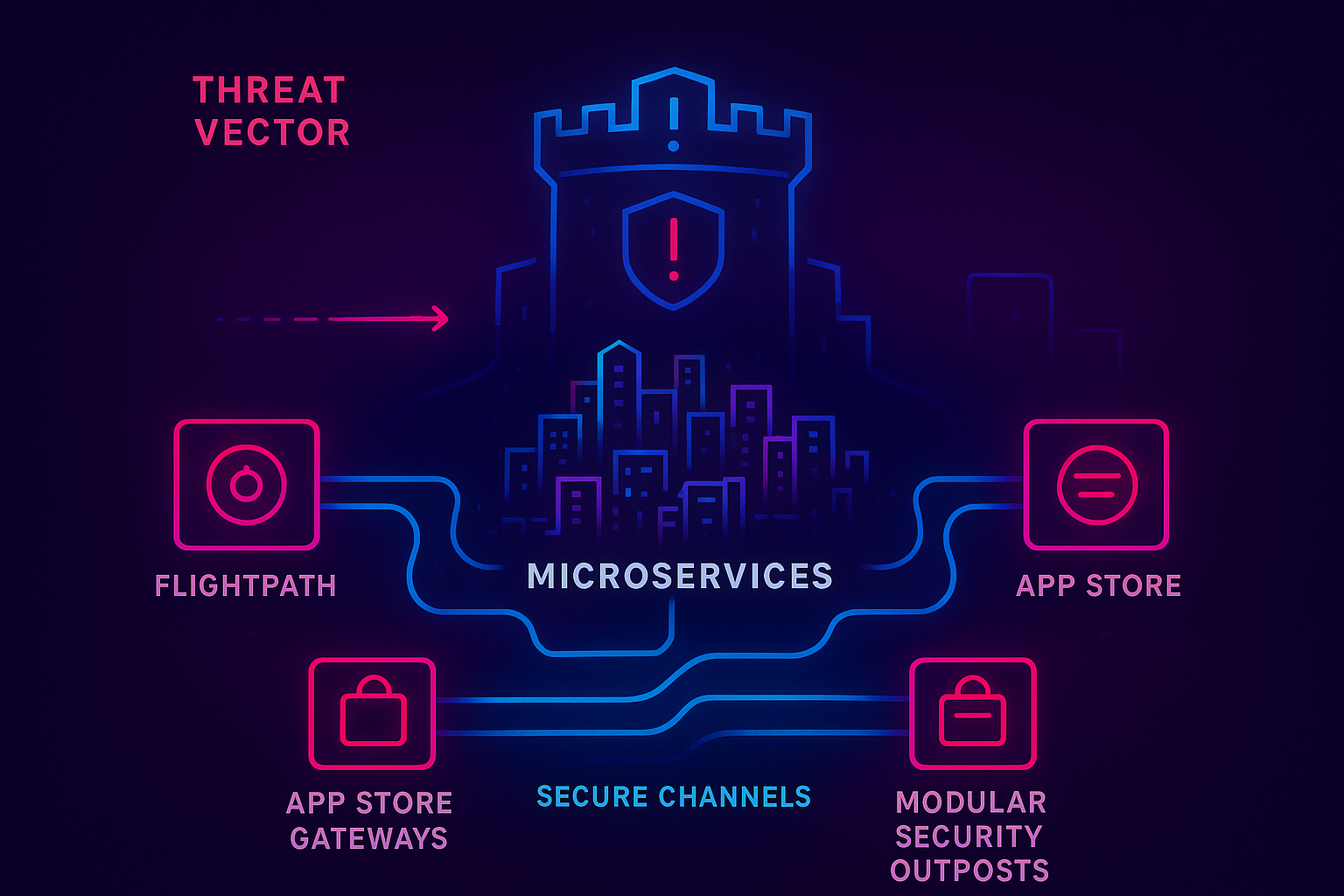
4. How FlightPath and App Store Work Together
The real power lies in the synergy between FlightPath and the App Store, a blend of dynamic routing intelligence and modular extensibility.Unified Workflow
- Traffic Entry: The ADC receives client requests at the edge.
- Health Check & Balancing: Requests are distributed to healthy servers.
- FlightPath Logic: Conditional rules inspect traffic, block threats, or route requests intelligently.
- App Store Modules: Security or microservice modules execute additional logic WAF filtering, authentication, or custom analytics.
- Resilience Layer: If a failure occurs, GSLB or backup logic from App Store ensures continuity.
This integration enables a resilient, secure, and adaptive application delivery framework capable of responding to new business and security needs in real time.
5. Industry Use Cases: FinTech and E-Commerce
5.1. FinTech Applications
FinTech platforms deal with highly sensitive financial data, regulatory compliance, and real-time transaction volumes. Edgenexus provides:
- Data Protection: Masking and filtering sensitive financial information at the edge.
- Zero Downtime: Active-passive clustering and GSLB prevent outages during trading peaks.
- Compliance Assurance: Easily configurable rule-sets ensure adherence to PCI-DSS and GDPR.
- Edge Security: Blocks suspicious API traffic before it reaches the backend.
5.2. E-Commerce Platforms
For e-commerce, performance and reliability directly influence revenue. Edgenexus helps by:
- Handling Massive Traffic Spikes: Even distribution prevents overload during seasonal sales.
- Bot Protection: Rules and WAF modules identify and block scraper or fraud bots.
- Checkout Resilience: Ensures continuous uptime during payment or checkout processes.
- Personalized Routing: Directs customers to the nearest or least-loaded data center for optimal response times.
Both industries benefit from reduced downtime, enhanced data privacy, and the ability to deploy updates faster without compromising on compliance or performance.
6.Key Features Aligned with Business Outcomes
| Feature | Business Objective | Impact |
| Layer 4/7 Load Balancing | Improve performance & reliability | Distributes load intelligently and prevents overloads. |
| Layer 4/7 Load Balancing | Improve performance & reliability | Distributes load intelligently and prevents overloads. |
| SSL/TLS Offload | Secure communication | Reduces CPU strain on backend servers and simplifies encryption management. |
| FlightPath Rule Engine | Application security & orchestration | Enables traffic manipulation, blocking, rewriting, and intelligent routing. |
| App Store Modules | Flexibility & scalability | Adds new capabilities without re-architecting infrastructure. |
| Microservice Hosting | Reduce latency | Run edge-native microservices close to the user. |
| GSLB & Geo-Routing | Disaster recovery | Maintains uptime and global performance. |
| Intuitive GUI | Operational efficiency | Simplifies management for DevOps and IT teams. |
7. Implementation Best PracticesTo maximize the potential of Edgenexus
- Define SLA and Resilience Goals: Know your acceptable downtime and failover needs.
- Segment Traffic Logically: Use FlightPath conditions (headers, geography, path) to optimize routing.
- Regularly Update Rule Sets: Adjust FlightPath logic as your application evolves.
- Govern App Deployments: Establish a review process for App Store modules.
- Test Failover Scenarios: Simulate disasters to confirm auto-routing works.
- Monitor Continuously: Use built-in dashboards and logging tools.
- Harden the Edge: Ensure your ADC software and modules are always patched.
- Document Everything: Maintain records of rules, modules, and policy versions.
8. Real-World Example: A Global Retail Platform
Imagine a large global e-commerce company running a major online sale event. Millions of customers access the platform simultaneously from multiple regions.
- The Edgenexus load balancer distributes traffic globally using GSLB.
- FlightPath identifies fraudulent bots through User-Agent headers and redirects them to a challenge page.
- A canary deployment sends 10% of traffic to a new payment microservice for testing.
- A WAF module from the App Store provides layer-7 threat detection and mitigation.
- In case of data center failure, traffic is instantly rerouted to another region.
- SSL offloading at the edge ensures fast checkout and secure communication.
The result: seamless scalability, zero downtime, and secure transactions during one of the busiest periods of the year.
9. Why Enterprises Choose Edgenexus
- Ease of Use: Intuitive GUI and drag-and-drop rule creation.
- Performance: High throughput and minimal latency even under heavy load.
- Extensibility: App Store approach keeps the platform adaptable to future needs.
- Affordability: Enterprise-grade features at a competitive price point.
- Security Focus: Inbuilt WAF, rule-based protection, and SSL handling at the edge.
Whether for a growing startup or an enterprise handling millions of daily transactions, Edgenexus provides a scalable and resilient foundation for modern applications.
10. Conclusion
Edgenexus FlightPath and App Store transform the traditional load balancer into a comprehensive Application Delivery Platform, capable of securing, orchestrating, and optimizing application traffic in real time.
By uniting intelligent rule-based management (FlightPath) with modular extensibility (App Store), organizations can:
- Enhance application security through precise traffic control and advanced threat protection.
- Achieve resilience with automated failover, health monitoring, and geo-distribution.
- Simplify microservices orchestration by hosting and managing services directly at the edge.
- Adapt faster to changing business or compliance requirements without major re-architecture.
For FinTech, e-commerce, or any enterprise running mission-critical applications, Edgenexus offers the perfect balance between flexibility, power, and simplicity.
Top FAQs
1. What is Edgenexus FlightPath?
FlightPath is a rule engine that lets you inspect, route, and manipulate application traffic in real time for enhanced security, compliance, and routing flexibility.
2. How does the App Store extend load balancer functionality?
It enables the installation of add-on modules, like WAF, GSLB, or microservices containers, directly onto the ADC for added flexibility and performance.
3. How does this solution improve application security?
By combining SSL offloading, WAF modules, and rule-based filtering, it ensures threats are mitigated at the edge before reaching backend servers.
4. Can FlightPath help manage microservices?
Yes. It allows routing by version, path, or header, perfect for microservice deployments, canary testing, and A/B experiments.
5. What role does the load balancer play in resilience?
It distributes traffic across multiple nodes, provides automatic failover, and ensures high availability even during server or network outages.
6. What industries benefit most from this stack?
FinTech, e-commerce, SaaS, healthcare, and any business that values security, uptime, and rapid application delivery.
7. Does the App Store support containerized apps?
Yes. The App Store can host containerized microservices directly on the ADC, reducing latency and improving scalability
8. How does global server load balancing (GSLB) help?
GSLB directs traffic based on user location and data center health, ensuring global performance and business continuity.
9. Is this platform cloud-compatible?
Yes. Edgenexus ADC can run on-premises, in public clouds, or hybrid setups, supporting modern digital infrastructures.
10. What sets Edgenexus apart from other load balancers?
Its combination of an intuitive rule engine (FlightPath), modular App Store, and integrated microservice orchestration makes it far more flexible and security-oriented than traditional ADCs.