

Banks and financial institutions operate some of the most mission-critical digital platforms in the world. From mobile banking and real-time payments to open banking APIs and trading systems, availability, security, and performance are non-negotiable.
Traditionally, many banks standardized on a single Application Delivery Controller (ADC) vendor. While this approach simplified operations in the past, it now introduces concentration risk, limits flexibility, and creates potential single points of failure.
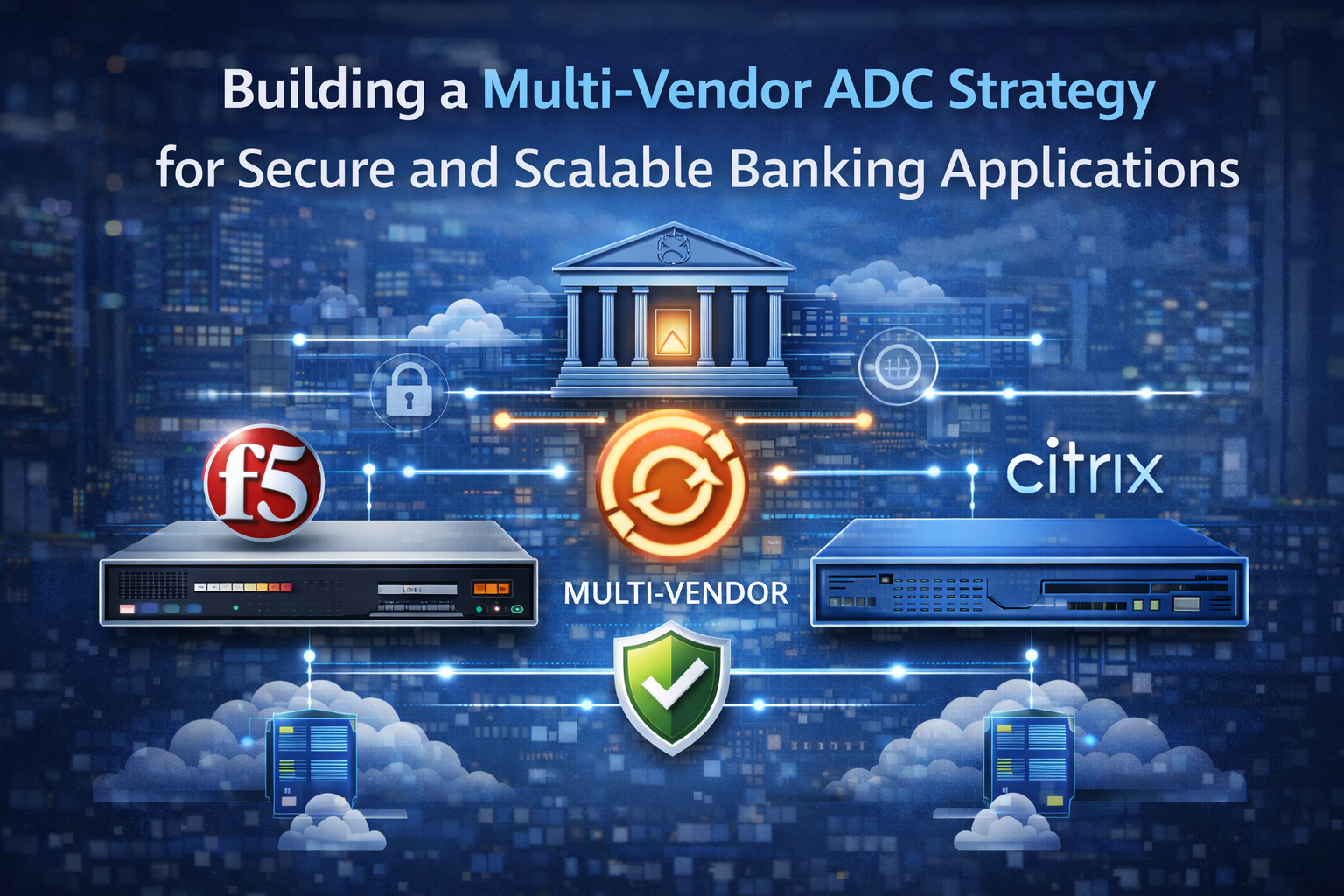
As regulatory pressure, cyber threats, and traffic volumes increase, leading financial institutions are adopting a multi-vendor ADC strategy—a deliberate approach that improves resilience, scalability, security, and vendor risk management.
Why ADCs Are Critical in Modern Banking
An ADC sits at the heart of digital banking delivery. It is responsible for:
- Load balancing application traffic (L4/L7)
- Ensuring high availability and failover
- Managing SSL/TLS encryption
- Protecting applications at Layer 7
- Optimizing performance during peak loads
For banks, the ADC is not just infrastructure—it is part of the trust layer that keeps digital services always available and secure.
The Limitations of a Single-Vendor ADC Approach
Many banks rely heavily on platforms such as F5 for core application delivery—and for good reason. F5 is proven, powerful, and widely trusted.
However, relying on a single ADC vendor introduces several risks:
1. Vendor Concentration Risk
If the platform experiences:
- Software defects
- Misconfigurations
- Licensing failures
- Supply chain issues
…critical banking services may be impacted.
2. Upgrade and Change Risk
Even planned upgrades or patches can introduce downtime when no secondary platform exists.
3. Cost and Licensing Rigidity
Scaling a single vendor platform often means escalating licensing and capacity costs.
4. Regulatory and Operational Resilience Concerns
Regulators increasingly expect:
- No single point of failure
- Vendor diversity
- Demonstrable failover testing
In modern banking, performance alone is not enough—resilience and diversification matter just as much.
What Is a Multi-Vendor ADC Strategy?
A multi-vendor ADC strategy uses two or more ADC platforms in a coordinated architecture to deliver:
- High availability
- Disaster recovery
- Vendor risk mitigation
- Operational flexibility
This does not mean replacing an existing platform. Instead, it means augmenting it with a complementary ADC that can assume traffic when needed.
Common Multi-Vendor ADC Models in Banking
1. Active-Passive Model
- Primary ADC handles production traffic
- Secondary ADC remains on standby
- Traffic shifts during incidents, maintenance, or testing
2. Active-Active Model
- Traffic is distributed across vendors or regions
- Improved resilience and load sharing
- Lower recovery time objectives (RTOs)
3. Disaster Recovery (DR) Model
Secondary ADC activated during:
- Regional outages
- Data center failures
- Cyber incidents
Often combined with DNS or Global Server Load Balancing (GSLB).
Security Advantages of a Multi-Vendor ADC Strategy
Security threats in banking are increasingly application-layer focused.
A multi-vendor ADC strategy improves security by:
- Reducing systemic exposure to a single vendor vulnerability
- Allowing traffic isolation during incidents
- Supporting layered defenses across platforms
- Enabling independent WAF and traffic-filtering policies
If one platform is under attack or investigation, traffic can be safely rerouted without customer impact.
Scalability and Performance Benefits
Banking traffic is highly unpredictable:
- Salary days
- Market volatility
- Fraud events
- Seasonal spikes
A multi-vendor ADC strategy allows banks to:
- Absorb traffic surges without over-provisioning
- Distribute load geographically
- Add capacity without locking into one cost model
- Improve global user experience
Scalability becomes elastic and strategic, not reactive.
Why Edgenexus Fits Naturally into a Multi-Vendor ADC Strategy
Edgenexus is increasingly adopted by banks as a secondary or complementary ADC because it integrates cleanly into existing environments.
Key reasons include:
Interoperability
Edgenexus works alongside incumbent platforms like F5 without disrupting current architectures.
Global Server Load Balancing (GSLB)
Enables intelligent traffic steering across:
- Regions
- Data centers
- Vendors
Critical for DR and cross-platform failover.
Integrated Security
Built-in Web Application Firewall (WAF) and SSL/TLS offloading protect banking applications during both normal and failover operations.
Hybrid & Cloud Readiness
Edgenexus runs:
- On-premises
- In a private cloud
- In the public cloud
Aligning with modern banking infrastructure strategies.
Operational Simplicity
Centralized management and automation reduce the operational burden of running multiple platforms.
Cost-Effective Resilience
Delivers enterprise-grade resilience without duplicating high-cost primary infrastructure.
Real-World Banking Scenarios for Multi-Vendor ADCs
Banks adopt multi-vendor ADC strategies for scenarios such as:
- Planned maintenance on primary ADC platforms
- Capacity exhaustion during traffic spikes
- Regional data center outages
- Security incidents requiring traffic isolation
- Regulatory resilience testing
- Vendor lifecycle or EOL planning
In each case, service continuity is preserved.
Key Best Practices for Building a Multi-Vendor ADC Strategy
- Clearly define primary vs secondary roles
- Use automated health checks and failover
- Integrate with GSLB or DNS-based routing
- Test failover regularly (not just on paper)
- Align strategy with regulatory requirements
- Ensure security policies remain consistent
A multi-vendor approach should be designed, tested, and governed, not improvised.
Conclusion
As banking applications become more digital, distributed, and regulated, single-vendor ADC strategies are no longer sufficient.
A well-designed multi-vendor ADC strategy enables banks to:
- Eliminate single points of failure
- Improve security posture
- Meet regulatory expectations
- Scale confidently
- Protect customer trust
By complementing existing ADC platforms with modern solutions like Edgenexus, banks can build secure, resilient, and future-ready application delivery architectures.
Next Steps
Explore how Edgenexus fits into a multi-vendor ADC strategy for secure and scalable banking applications.
Learn how banks use Edgenexus alongside existing platforms to strengthen resilience without disruption.
Frequently Asked Questions (FAQs)
1. What is a multi-vendor ADC strategy in banking?
A multi-vendor ADC strategy uses more than one application delivery controller from different vendors to reduce single points of failure, improve resilience, and manage vendor risk in banking infrastructure.
2. Why are banks moving away from single-vendor ADC architectures?
Single-vendor ADC architectures increase operational risk, limit flexibility, and create dependency on one platform for availability, security, and scalability—factors regulators increasingly scrutinize.
3. How does a multi-vendor ADC strategy improve banking resilience?
It enables automated failover, cross-platform traffic routing, and disaster recovery, ensuring banking applications remain available during outages, upgrades, or security incidents.
4. Is a multi-vendor ADC strategy required by banking regulators?
While not always explicitly required, regulators expect banks to demonstrate operational resilience, vendor risk management, and the absence of single points of failure in critical systems.
5. Can banks run multiple ADC vendors without increasing complexity?
Yes. When designed correctly using automation, GSLB, and centralized monitoring, a multi-vendor ADC strategy can reduce risk without significantly increasing operational complexity.
6. How does Global Server Load Balancing (GSLB) support multi-vendor ADC setups?
GSLB intelligently routes traffic across regions and ADC platforms based on health and performance, making it ideal for cross-vendor failover and disaster recovery.
7. Does a multi-vendor ADC strategy improve application security?
Yes. It reduces systemic exposure to vendor-specific vulnerabilities and allows traffic isolation during security incidents while maintaining service availability.
8. Can Edgenexus be used alongside existing ADC platforms like F5?
Yes. Edgenexus is commonly deployed as a complementary ADC alongside platforms like F5 to provide backup, failover, and additional resilience without replacing existing infrastructure.
9. How does a multi-vendor ADC strategy help with traffic spikes in banking?
It allows banks to distribute traffic across multiple platforms and regions, absorbing peak demand without over-provisioning a single ADC vendor.
10. What business outcomes does a multi-vendor ADC strategy deliver for banks?
It improves uptime, strengthens regulatory compliance, reduces vendor risk, enhances security, and ensures scalable performance for always-on digital banking services.